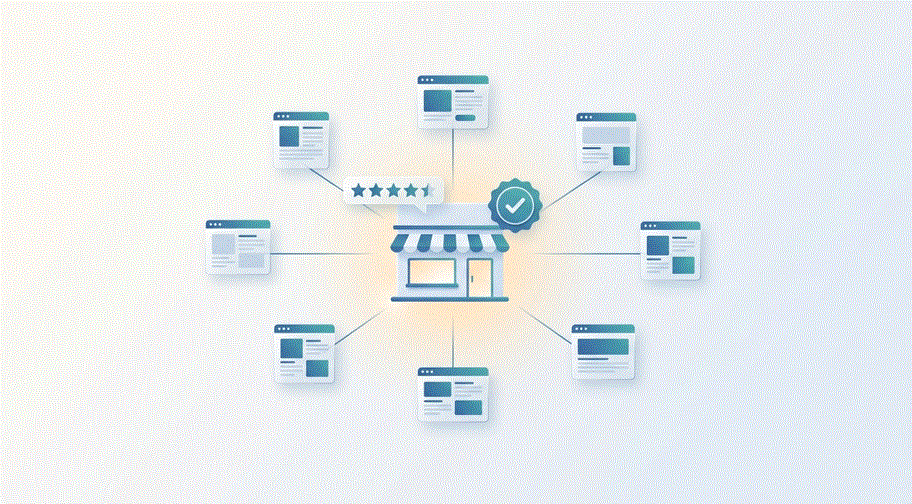
A stranger decides whether to trust your business in about the time it takes to skim one search result. Most owners never think about those few seconds, and it quietly costs them customers every week.
It is tempting to believe that trust is earned slowly, over years of good work. That is true for the reputation you build with existing customers. But for the person who has never heard of you, trust is a snap judgment made from whatever they can find in a hurry. Two businesses can offer the identical product at the identical price, and the one that looks more credible in those first moments wins.
The good news is that credibility is not a mystery or a matter of luck. It is a set of signals you can build on purpose. This article walks through what those signals are, and how a small business can put them in place without a big marketing budget.




The first impression happens before you say a word
Think about the last time you considered buying from a company you did not know. You almost certainly searched their name. You skimmed their website, glanced at a few reviews, and maybe checked whether anyone reputable had written about them. Within a minute you had formed an opinion, and that opinion decided whether you kept going or clicked away.
Your customers do exactly the same thing to you. The difference is that most owners have never looked at their own business the way a stranger does. They see the years of effort behind the brand. A first-time visitor sees only the surface: a website that either looks professional or does not, a scattering of reviews that are either recent or stale, and a search page that either shows the signs of a real, established company or shows almost nothing at all.
That surface is your first impression, and it is being made whether you manage it or not. The only question is whether it works for you or against you.
The three signals of a credible business
When someone sizes up an unfamiliar business, three signals do most of the work.
The first is a consistent presence. Your name, your branding, and your basic details should look the same wherever they appear: on your site, your social profiles, and any listing that mentions you. Inconsistency reads as carelessness, and carelessness reads as risk.
The second is social proof. People trust what other people have already trusted. Reviews, testimonials, visible customer numbers, and active social accounts all tell a newcomer that others took the leap and were fine. A business with no visible proof asks every new customer to be the brave first, and most people would rather not be.
The third, and the one most small businesses neglect, is independent validation. This is when someone other than you vouches for you: a journalist who quotes you, a publication that features you, an industry site that lists you. It carries more weight than anything you say about yourself, because you did not write it. A newcomer weighs a sentence in a real publication far more heavily than a paragraph on your own homepage. Most owners work hard on the first two signals and ignore the third, and that is the gap worth closing.
Why being talked about beats talking about yourself
There is a simple reason third-party coverage outperforms self-promotion: it is not you. Everyone expects a business to praise itself, so those claims get mentally discounted. When an outside source says the same thing, the skepticism drops, because that source has no obvious reason to flatter you.
This is why a single mention in a recognised outlet can do more for a new business than months of its own social posts. It is not really about the traffic that mention sends, which is often modest. It is about what it signals. Once a real publication has written about you, your search results tell a different story. A newcomer who looks you up finds not just your own pages but other people talking about you, and that shifts the whole impression from unproven to established.
The obstacle for most small businesses is the belief that coverage requires either luck or an expensive agency. Neither is true anymore. There are platforms built specifically to connect businesses with publications and put their news in front of editors and audiences, and a marketplace like essentras.com exists to make that reachable for companies that do not have a PR firm on retainer. The mechanics of getting mentioned are more accessible than they have ever been. What most owners lack is not budget, it is the awareness that this lever exists at all.
The point is not that you should stop promoting yourself. It is that your own voice and an outside voice do different jobs, and the outside voice is the one that closes the trust gap fastest.
How to earn coverage without a big budget
Earning coverage on a lean budget comes down to a repeatable process rather than a big spend.
Start with something worth talking about. Coverage follows a story, not a request for attention. A launch, a milestone, a piece of original data, a genuine local angle, or a clear point of view on something happening in your industry all give a writer a reason to care. “We are open” is not a story. “We surveyed two hundred local customers and found something surprising” is.
Next, take that story to the right places rather than everywhere. A handful of publications and writers who actually cover your space is worth far more than a mass blast to outlets that will never run it. Read what they publish, and shape your angle to fit what they already care about.
Then get the announcement out where it can be found and picked up. This is where distribution earns its place. Beyond pitching individual writers, publishing your news through Essentras and its network of outlets puts your announcement somewhere indexable, so it surfaces when people search your name and gives editors an easy path to run it. If your immediate need is simply getting a formal announcement live and in front of publications, getting a press release published handles exactly that while you keep the relationship-building in your own hands.
Finally, be patient and consistent. Most coverage does not come from the first attempt. It comes from a steady rhythm of small, well-targeted stories over time, each one adding another independent voice to your search results. A business that does this a few times a year will, within a year, look markedly more established than a competitor that never tries, regardless of which one is actually bigger.
What to do once you are mentioned
Coverage is only half the value. The other half comes from what you do with it, because a mention that sits unused on someone else’s site helps far less than one you put to work.
Add it to your own world. A simple “as featured in” line on your homepage, a link in your email signature, and a short post sharing the piece all borrow the outlet’s credibility and point it back at you. Keep a running list of everywhere you have been mentioned, so the proof accumulates over time instead of scrolling out of memory and being forgotten.
Then reuse the angle. A story one publication ran is often interesting to others, and a quote or statistic that worked once can anchor your next pitch. Coverage compounds when you treat each mention as the start of the next one rather than a finish line, and that momentum is what eventually makes a small business look far bigger than its headcount.
See also: The Boston Business Upgrade Nobody Talks About Enough
Turning credibility into customers
Credibility is not an end in itself. It works because it removes hesitation at the exact moment someone is deciding whether to buy.
Picture two versions of the same first-time visitor. One searches your business and finds a clean site, recent reviews, and a mention or two in real publications. The other finds a thin site, a couple of old reviews, and nothing else. The first visitor’s guard comes down and they read on. The second hesitates, and hesitation at the point of decision usually ends in a closed tab.
Everything covered here, a consistent presence, visible proof, and independent validation, is really about winning that one moment. You are not trying to impress everyone. You are trying to give the person who is already interested no reason to doubt you. Do that reliably, and credibility stops being a soft, vague goal and becomes a direct contributor to sales.
None of this requires a large budget or a marketing department. It requires seeing your business the way a stranger does, then closing the small gaps that make a good company look uncertain. Fix the surface, gather your proof, and get a few credible outsiders to vouch for you, and the trust that used to take years starts arriving in the first few seconds instead.