Most people choose a pillow by squeezing it in a shop or picking whatever is on special, then wonder why they wake with a stiff neck. Health authorities point to a simpler test. The right pillow is the one that keeps your head and neck in line with the rest of your spine in the position you actually sleep in, and that depends far more on pillow height and shape than on price.
That idea is behind the growing interest in contoured designs, including the butterfly pillow, which has a dip in the centre and raised wings on either side. One Australian bedding brand has published a guide to finding the best butterfly pillow Australia wide, setting out how the shape is meant to support back and side sleepers and what buyers should weigh up, including material, firmness, loft, and how the pillow fits a standard case.
What the health advice actually says
Healthdirect, the Australian Government’s health information service, lists sleeping with the wrong type of pillow among the common causes of neck pain, alongside poor posture, long stretches at a computer without a break, and muscle strains. It is a modest statement, but it puts the pillow on the same list as the desk setup that most workplaces now take seriously.




The NHS in the United Kingdom goes a step further in its self-care advice for neck pain. It suggests using a low, firm pillow and a firm mattress, and it advises against sleeping on your front or twisting your neck in bed. HealthLink BC, the Canadian provincial health service, frames it in terms of alignment. Its guidance is to use a pillow that keeps the neck straight, neither too high nor too flat, that does not push the head forward when you lie on your back, and that lets your nose line up with the centre of your body when you lie on your side.
None of these sources endorse a particular pillow shape. What they share is a focus on position, which is useful because it gives sleepers something they can check for themselves at home.
See also: The Blueprint for Modern Aging in Place: Integrating Personal Care, Companionship, and Smart Tech
Back sleepers and side sleepers need different things
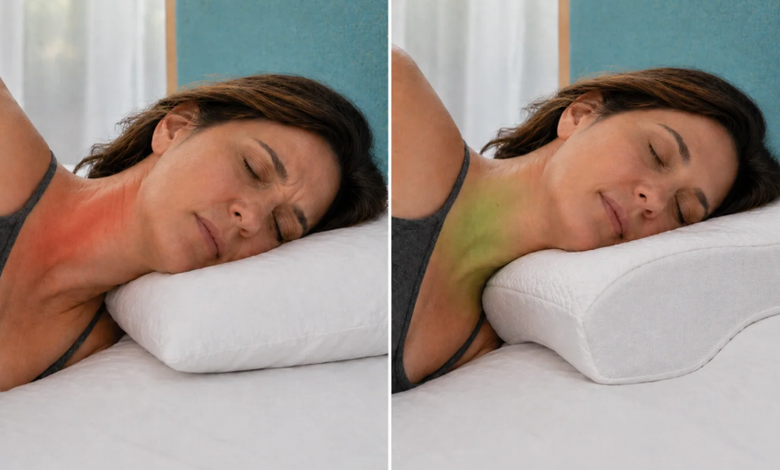
The gap between your head and the mattress changes a great deal depending on how you lie. On your back, the head only needs to be raised a little, and a pillow that is too thick tips the chin towards the chest. On your side, the distance from the ear to the outer edge of the shoulder has to be filled; otherwise, the head drops towards the mattress and the neck bends sideways all night.
This is the problem contoured pillows try to solve. The lower central section is intended for lying on your back, while the higher wings are meant to fill the space between head and shoulder when you roll onto your side. In practice, most people change position several times a night, so a pillow that offers two heights in one can make sense for combination sleepers.
Front sleepers are the exception. The guide notes that stomach sleepers may find butterfly pillows less comfortable, and the NHS advice discourages front sleeping for people with neck pain anyway, because the head has to be turned to one side to breathe.
Expect an adjustment period
A shaped pillow can feel odd at first. The same guide describes a short settling-in period of a few nights while the unfamiliar contours start to feel normal, and it lists pillowcase fit as a genuine drawback, since standard cases may not sit neatly over the curved shape. Those are small practical points, but they are the sort of thing that leads people to give up on a pillow before they have properly tried it.
A sensible approach is to give any new pillow at least a week before judging it, and to pay attention to how your neck and shoulders feel in the first hour after waking rather than how the pillow feels the moment your head touches it.
A quick test at home
Anyone can run a rough check with a phone camera and a helper. Lie on your side in your usual position and have someone photograph you from behind or from the foot of the bed. If the line from the middle of your forehead to your chin runs roughly parallel with the mattress and lines up with the centre of your chest, the height is close. If your head tilts down towards the mattress, the pillow is too low. If it tilts up towards the ceiling, it is too high.
Repeat the exercise on your back. Here, the aim is for your face to point straight up rather than your chin being pushed towards your chest. A pillow that passes both tests is doing the main job the health advice describes, whatever shape it happens to be.
Why it is worth the effort
Poor sleep is common in Australia. A report commissioned by the Sleep Health Foundation, Asleep on the Job, estimated that 39.8 per cent of Australian adults experience some form of inadequate sleep, with effects on learning, decision-making, and the risk of mental and physical illness. A pillow will not fix every cause of that, and anyone with ongoing or severe neck pain, pain that spreads into the arms, or numbness should see a GP or physiotherapist rather than relying on new bedding.
For everyone else, matching pillow height to sleeping position is one of the cheaper changes available. It does not require a new mattress or a gadget, just an honest look at how you lie at night and whether your pillow is holding your neck where it belongs.
Materials and climate
The other choice buyers face is what the pillow is made of. The Australian guide suggests looking for breathable materials such as memory foam infused with cooling gel or natural latex, and notes that allergy sufferers may prefer fillings and covers that resist dust mites. In a warm climate, a pillow that traps heat can be as disruptive as one that sits at the wrong height, so it is worth checking whether the cover can be removed and washed, and how the filling is likely to feel on a humid summer night.
Care instructions vary widely between materials, and the safest course is to follow the label on the specific pillow rather than general rules. A removable cover that goes through the washing machine makes regular cleaning far more likely to happen.