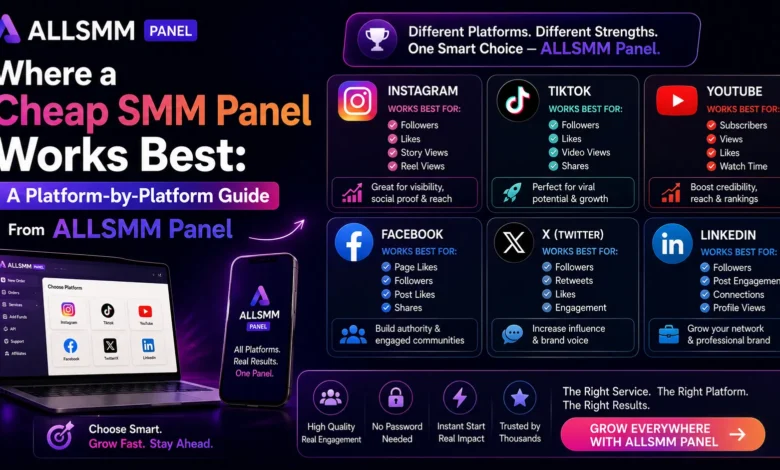
Here is a mistake I see people make constantly. They find one growth strategy, it works a little on Instagram, and then they copy the exact same approach onto TikTok, YouTube, and everywhere else. Then they wonder why the results feel flat. The truth is that every platform rewards something different, and the smart way to spend a small budget is to match your order to what each app actually values.
I have run growth across all the major platforms for years, and the differences are bigger than most beginners realize. Buying 1,000 followers means one thing on Instagram and almost nothing on TikTok. A view has completely different weight on YouTube than it does on a Telegram channel. So instead of one generic tip, let me walk you through each major platform, what it rewards, and where a cheap SMM panel gives you the most bang for a tight budget.
Why one strategy does not fit all platforms
Every social platform has its own engine. Instagram cares heavily about how a profile looks at a glance and whether posts get early engagement. TikTok barely cares about your follower count and obsesses over how a single video performs in its first hours. YouTube weighs views and watch time. Telegram runs on the credibility of a channel rather than a feed algorithm.




If you pour the same order into each one, you waste money on things that platform does not reward. Understanding the engine is the whole game. Once you know what each app is looking for, you can spend a tiny budget precisely where it moves the needle instead of spreading it thin and hoping.
Instagram: buy trust, not just numbers
Instagram is a visual first-impression platform. When someone lands on your profile, they scan your follower count, your grid, and the likes on your recent posts in about two seconds, then decide whether you are worth following. That means on Instagram, the goal is balance and credibility, not a giant follower wall.
For Instagram I recommend a modest, believable follower base paired with likes spread across your recent posts. A profile with 4,000 followers but only six likes per post looks broken and actually scares people off. A profile with 1,500 followers and steady likes on every post looks like a real, active account someone would want to join. Reach for balance here, because Instagram punishes lopsided profiles harder than almost any other app.
TikTok: it is all about the video, not the follower count
TikTok is the platform where beginners waste the most money, because they buy followers out of habit. On TikTok, followers barely matter. The algorithm decides whether to push a video based on how that specific video performs in its first hours, especially views and watch-through.
So on TikTok, put your budget into video views, not followers. A new clip that jumps to a few thousand views quickly signals to the algorithm that people find it interesting, which can trigger it to show the video to a wider audience organically. That is the real leverage on TikTok. A follower count sitting on your profile does almost nothing, but early momentum on a video can snowball into genuine reach.
YouTube: views and watch time carry the weight
YouTube behaves more like a search engine and a recommendation machine than a social feed. It rewards videos that pull views and, crucially, hold attention. A big subscriber number looks nice, but on YouTube it is views and watch time that tell the platform your content is worth recommending.
For YouTube, focus your budget on views for videos you genuinely believe in. The point is to give a promising video an early nudge past the dead zone where good content dies from zero visibility. Pair that with a modest subscriber boost so your channel does not look brand new, and you have a credible base. But the heavy lifting on YouTube comes from views, so weight your spend there.
Telegram: credibility runs the channel
Telegram is different from all of them because there is no discovery feed shoving your channel in front of strangers. Growth comes from shares, links, and word of mouth. That means when someone finally lands on your channel, it needs to look established or they leave instantly.
For Telegram, the mix is subscribers for headline credibility, post views that accumulate on each new post, and a few reactions so the channel reads as active. An empty-looking Telegram channel with 20 subscribers and no views on any post kills trust immediately. A channel that looks populated and active gives new visitors a reason to stay and subscribe.
Where a cheap SMM panel fits into all this
This is exactly why service depth matters so much. If your provider only sells Instagram followers, you cannot run a platform-smart strategy. You end up buying the wrong service just because it is the only one available, which is how budgets get wasted. A good cheap smm panel that covers every platform lets you match the exact service to the exact app, so every dollar goes where that platform actually rewards it.
That flexibility is the difference between a scattershot spend and a precise one. When you can order TikTok views, YouTube watch time, Instagram likes, and Telegram subscribers all from one place, you stop forcing a single strategy onto platforms that want completely different things.
The speed question: fast start, natural finish
Across every platform, one rule holds. You want the order to start quickly so you know it is working and, on TikTok and YouTube, so the boost lands while the content is fresh. Waiting many hours with nothing happening is both nerve-wracking and, on video platforms, a wasted opportunity because the algorithm has already moved on.
But you do not want everything delivered in one instant burst. A video that jumps from 40 to 20,000 views in sixty seconds looks fake and can do more harm than good. The ideal is a fast start followed by natural pacing, and a reliable smm panel gives you exactly that: quick to begin, gradual to finish, which reads as organic on every platform.
A quick real example
I helped a small accessories brand that was spreading a tiny budget evenly across four platforms and getting nowhere. We stopped the even split. On Instagram we added a modest follower base plus steady likes for credibility. On TikTok we ignored followers entirely and put the budget into views on their two best product clips. We left YouTube alone since they barely used it, and gave their small Telegram channel a light subscriber and view boost.
Same total budget, completely different allocation. Within two weeks the TikTok clips had picked up real organic reach because the early view boost triggered wider distribution, and the Instagram profile was converting far more visitors into followers because it finally looked credible. Nothing about the spend changed except matching it to what each platform rewarded.
See also: The Blueprint for Modern Aging in Place: Integrating Personal Care, Companionship, and Smart Tech
How to choose a panel for a multi-platform strategy
If you are going to grow across platforms, pick a provider that supports all of them properly. Look for real service depth covering Instagram, TikTok, YouTube, and Telegram, not just one app. Look for the ability to start with a small order so you can test. Look for solid retention so your numbers do not evaporate in a week. And look for support that actually answers when something stalls.
The cheapest option that only covers one platform will cost you more in the long run, because you end up stitching together multiple providers and multiplying your points of failure. One affordable panel with genuine range keeps your whole strategy simple and consistent.
Common mistakes to avoid
A few traps I see over and over across platforms:
- Buying followers on TikTok when views are what actually drive the algorithm.
- Ignoring likes and engagement on Instagram, leaving a lopsided profile that scares people off.
- Chasing subscribers on YouTube while neglecting the views and watch time that trigger recommendations.
- Letting a Telegram channel look empty because you only bought subscribers with no views or reactions.
- Dumping everything instantly instead of pacing it to look natural.
The takeaway
There is no single growth trick that works everywhere. Instagram wants a credible, balanced profile. TikTok wants early video momentum. YouTube wants views and watch time. Telegram wants a channel that looks established. Spend your budget according to what each platform actually rewards, and even a small amount goes a long way.
Match the service to the platform, pace the delivery, and test before you scale. Do that with a panel that covers every app, and you turn a tight budget into real, platform-smart growth. From what I have run, allsmm.net has the range and the retention to make this approach work, but the real proof is simple: run a small order on whichever platform matters most to you, watch it for two weeks, and let the results decide.
FAQ
Should I buy followers on every platform?
No. Followers matter most on Instagram and Telegram for credibility, but on TikTok and YouTube the algorithm cares far more about views and watch time. Buying followers on those platforms is often wasted money. Match the service to what each platform rewards.
Why are views more important than followers on TikTok?
Because TikTok decides whether to push a video based on how it performs early, not on how many followers you have. A clip that gains views quickly signals interest and can get shown to a much wider audience. Followers sitting on your profile do almost nothing for reach.
Can I use one panel for all my platforms?
Yes, and you should. A panel that covers Instagram, TikTok, YouTube, and Telegram lets you match the exact service to each app from one place. Using separate providers for each platform multiplies your admin and your points of failure.
How fast should delivery be?
The order should start quickly, within minutes, especially on TikTok and YouTube where timing matters for the algorithm. But the full delivery should pace out naturally over hours rather than arriving in one instant burst, which looks fake on every platform.
Is a cheap panel good enough for a real multi-platform strategy?
It can be, as long as cheap does not mean low quality. A lean provider can stay affordable while keeping retention high and covering every platform. Judge it on results that stick and on service range, not on the sticker price alone.
How much should I spend to start?
Ten or twenty dollars is plenty for a first test. Put it into the platform that matters most to you, using the service that platform rewards, and watch the results for two weeks before scaling up or expanding to other apps.