How Aerospace-Grade Titanium Achieves Consumer Electronics’ Impossible Lightweight Goals: A Manufacturing Analysis

Introduction
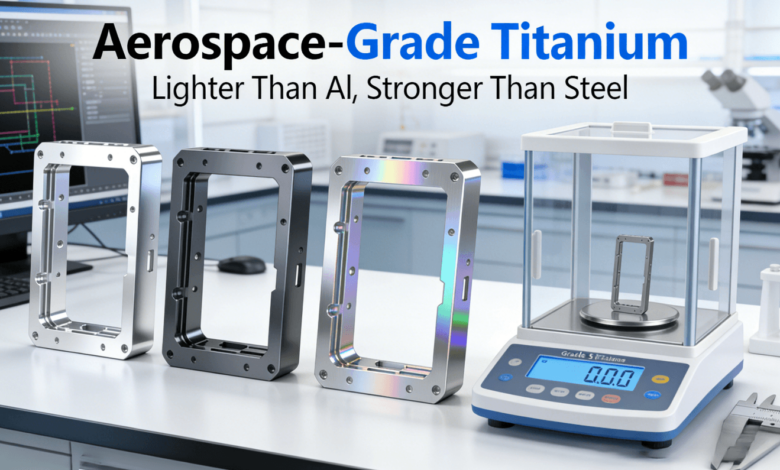
In the quest for the absolute minimum weight reduction in consumer electronics, aerospace products, and medical devices, engineers are constantly faced with a compromise: a material that provides adequate strength or a material that provides a manageable weight. Current aluminum alloys, for instance, are too light for the task but sorely lack the strength requirements for the next generation of products. Stainless steel provides adequate strength at a considerable penalty in weight. Carbon fibers are very light and strong, but the challenge has been to make them in complex forms for mass production. Thus, the designers have always been looking for a material which will be “lighter than aluminum yet stronger than steel.”
Whether such a material that provides very high strength-to-weight ratios, high durability, and high-precision mass production capability really exists, is a question. Grade 5 Titanium (Ti-6Al-4V), which is a high-grade material mainly used for aerospace products, can be the next generation of products that require ultra-light components with high strength-to-weight ratios. However, moving from aerospace products to consumer products involves various challenges that arise during high-precision CNC machining processes.
What Makes Grade 5 Titanium the “Holy Grail” for Lightweighting?
Grade 5 Titanium is primarily a titanium alloy with aluminum and vanadium (Ti-6Al-4V). It is considered a benchmark material for designers looking for a combination of low weight and high strength. What makes Grade 5 Titanium really stand out is its excellent specific strength, which is the strength-to-density ratio.This means that, for the same level of performance, the part made out of Grade 5 Titanium can be significantly thinner and lighter than the one made out of aluminum or stainless steel. This is the main reason why Grade 5 Titanium has been adopted in the aerospace industry, where the aircraft’s weight is directly related to fuel efficiency.




- A Data-Driven Performance Comparison: For instance, Grade 5 titanium has approximately twice the yield strength of 6061 aluminum, while its density is only increased by 60%. The outcome is it offers a better strength-to-weight ratio. Remarkably, it also has a high resistance to fatigue and great fracture toughness, meaning it can endure multiple stress cycles without failure- a vital characteristic for a product expected to be used by consumers over a long period. Furthermore, it forms a natural protective oxide layer that makes it highly resistant to corrosion, even better than stainless steel, ensuring that the product not only performs well but maintains its appearance as well.
- The Aerospace Heritage and Material Authority: The performance profile of Grade 5 titanium is not based on theory but on actual, combat-tested experience. It is the material of choice for critical applications in aerospace, from airframe parts and landing gear, to jet engine components. The choice of this material is supported by extensive research and critical material specifications. The decision is also supported by reputed agencies like ASM International, which provide exhaustive data on its metallurgy and properties. This makes it a premium, performance-oriented material. The use of this material in consumer electronics is a measure of the electronics industry’s desire for aerospace-level performance in a device small enough to fit into a pocket.
- The Foundation for Revolutionary Design: Thus, Grade 5 titanium is not just another material but a platform for new-age design. It is now possible for product developers to conceive of designs that are not just thinner, stronger, and more durable but also more capable of delivering on these characteristics. The use of this material is a measure of a new benchmark, from designing within material constraints to designing within material possibilities.
From Aircraft to Your Pocket: The Engineering Challenge of Scaling Down
Moving grade 5 titanium from large-scale aircraft structures to the intricately miniaturized components of consumer electronics is not a scale-up, but an exponential increase in manufacturing complexity. The issues don’t scale from material properties to feature-level material behavior. When dealing with a thin-walled smartphone casing or a precision watch case, residual stresses, thermal warping, and micro-cracking become critical issues. The room for error has decreased from millimeters to microns, a level of process control that is orders of magnitude greater than conventional machining.
1. The Physics of Miniaturization and Thin-Wall Machining
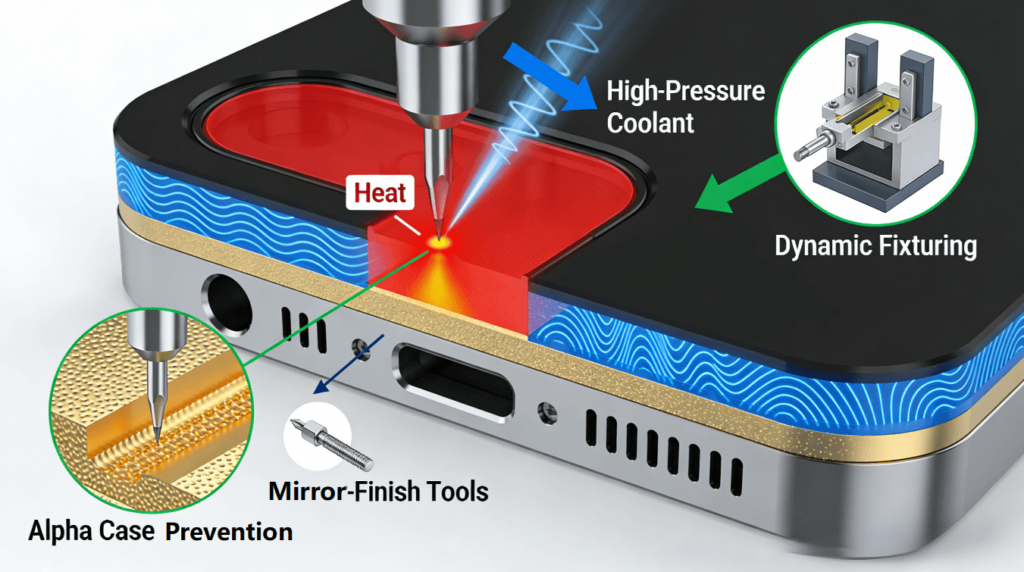
Essentially, the main challenge lies in the high forces involved at a microscopic level. In the machining of thin walls made from titanium alloy, the forces and heat generated can cause the material to deflect, vibrate, and even distort, thus producing a part that may not be within the required tolerance limits. In addition, the low thermal conductivity of the alloy causes the generated heat to be concentrated at a microscopic point where the cutting tool and the workpiece intersect. This can cause the material to change its structure at the microscopic level, thus producing a hardened “alpha case” layer on the workpiece’s surface.
2. Achieving Macro-Stability for Micro-Features
This requires a holistic approach to engineering. This includes workholding fixtures designed for maximum support without introducing stress. It also includes adaptive cutting strategies where light cuts are taken successively to gradually reveal the final form without introducing stress. The entire cutting system, from the base of the machine constructed from granite to the coating on the cutting tool, must be engineered for maximum rigidity and damping to prevent vibration from being felt by the ultra-thin part. This is a precision cutting process that can be considered more sculpting than cutting the high-performance material.
3. The Convergence of Advanced Technologies
Thus, scaling down successfully is a multidisciplinary achievement in the field of precision engineering. It is the convergence of the latest metallurgy, the latest machine tool technologies, and the latest software simulation technologies. As discussed in the SAE International advanced literature on engineering, the challenges posed by the micro-properties of the material for small-scale applications are a frontier challenge for modern manufacturing. This challenge is an industrial innovation, demonstrating the feasibility of the latest materials for consumer products through the refinement of technologies.
Why is CNC Machining the Only Viable Path for Precision Titanium Parts?
For high integrity complex Grade 5 Titanium parts, there are virtually no other options than multi-axis CNC machining. Though Additive Manufacturing (3D printing) has the ability to create complex geometries, it lacks the density, surface finish, and material properties that are needed for Titanium parts. Titanium parts also have a high complexity that cannot be achieved with forging processes; however, CNC machining provides parts that have fully dense material properties with a high surface finish that can have tolerances in the single-digit microns.
1. The Non-Negotiable Requirements for Machining Titanium
To effectively machine Grade 5 Titanium, a specialized ecosystem is necessary. This entails a machine that is highly statically and dynamically rigid, designed to handle the immense cutting force without flexing. It also entails cutting tools that are designed with specialized geometries and ultra-hard coatings, such as AlTiN, which is necessary for handling the heat. It also entails a coolant that is necessary for flushing chips and handling the immense heat that is produced. It is this combination that enables precision titanium CNC machining.
2. The Critical Role of Process Stability and Data
Consistency is the king in mass production, and the optimized parameters and tool paths are not fixed. They are constantly being checked, verified, and enhanced through the data obtained from in-process sensors and post-process inspections. This ensures that the 10,000th shipping item is equal in material and size accuracy to the first item. It is this very feature: At last, the decision to use a material such as Grade 5 titanium is a very deliberate strategy, and a very long term strategy at that.
3. Partnering for Integrated Manufacturing Success
The selection of a manufacturing partner is, therefore, a strategic decision. The intricacy of machining grade 5 titanium parts to consumer electronics standards requires a manufacturing partner who can deliver an integrated value proposition. This is especially so when working on projects requiring the highest standards of reliability and geometric intricacy. To engineers seeking to deliver the next generation of custom CNC precision parts, working alongside a manufacturing partner who can deliver mastery of this whole value chain, from digital design through physical validation, is the single most important factor in turning a dream into a commercial success.
See also: The Zombie Subscription: Firms Waste Millions on Unused Tech Tools
Case in Point: Achieving Mass Production of Ultra-Light Titanium Frames
The theory of precision meets the demands of mass production for a component such as a smartphone’s titanium mid-frame. This process begins not with a discussion of cutting, but rather a discussion of material properties, where aerospace-grade Ti-6Al-4V billets are procured, ensuring proper chemistry, and stress relief heat treatment is performed to ensure a stable state for the material. The billet is placed within a highly precise 5-axis CNC machine, where a series of operations is performed, including a roughing operation, which removes a majority of the material, a semi-finishing operation, which closely approximates the final state, and a finishing operation, which utilizes specialized tooling for the highest speed cuts for achieving precise dimensions on thin walls.
1. Mastering the Final Microns and Surface Integrity
The finishing touches are when the functional and visual properties of a part are established. Tools with mirror finish flutes and nano-level edge preparation are employed at precisely calculated velocities and feedrates. The goal is to achieve a surface devoid of tears, burns, or stresses, which can lead to a crack. The machining of features like antenna lines and button hole positions is accomplished with micron-level accuracy, ensuring seamless interfaces with other parts. Every operation is closely monitored, with in-process probing of critical dimensions taking place so that automatic tool compensation can be applied.
2. The Systems Behind Scalable Quality
“Building a perfect frame is a great achievement, but building a million perfect frames is a different story.” This ability to scale quality, as opposed to just quantity, is made possible by a robust quality management system that ensures complete traceability from raw material lot to finished product, statistical process control on key attributes, and 100% inspection of critical features. This ability to deliver this level of quality at scale is what differentiates a job shop from a manufacturing partner, and it’s the physical embodiment of the discipline that international standards require, ensuring that everything that reaches the end consumer does so with the high standards expected of premium brands.
3. Realizing the Vision Through Manufacturing Partnership
The successful mass production of these types of components is a true example of collaborative innovation. It is a process where the designer of the product and the manufacturing engineer partner very closely. As discussed in various successful project analyses, this process is not just about machining but also involves innovation in design, such as the use of hybrid metal structure designs. It also involves process optimization. The manufacturer’s expertise in grade 5 titanium CNC machining services and ultra light CNC machined parts turns a vision into reality, proving that these types of materials can be mastered for consumer use.
Beyond the Hype: A Realistic Look at Cost vs. Performance
As a cost investment, the use of Grade 5 Titanium is a decision that needs to be assessed from a cost vs. performance point of view. The cost factors are considerable: the cost of the raw material is high, the machine time is increased by the need for conservative cutting parameters, and the tooling is short-lived. Yet, the cost argument does not take into consideration the performance premium and the market advantage the investment will provide: a product that is perceptibly lighter and more premium, possibly even one that can fit a larger battery into the same space, or one that can be priced higher than the competition.
1. Optimizing Design for Manufacturability (DFM)
The strongest cost control measure is implemented at the design stage through expert DFM. A seasoned manufacturing partner with considerable expertise in working with titanium can propose design changes that can significantly minimize cost without affecting performance: combining two or more components into one monolithic part, rationalizing the thickness and radii for tool accessibility, and establishing tolerance requirements that are “fit for function” rather than unnecessarily precise. A marginal change to the design based on Material Science and the realities of manufacturing can save 30% on machining time or double tool life, which translates to cost savings.
2. Calculating Total Value, Not Just Unit Cost
Thus, the business case for titanium is based on total value of ownership. It is a question of whether the weight reduction improves the user experience, driving sales volume? Does it reduce warranty costs because of improved strength and corrosion resistance? Does it improve brand image because of the prestige of using titanium? A company can make an informed decision by working with a manufacturer who can provide transparent cost information and value engineering assistance. The right partner can help companies balance the benefits of using Grade 5 titanium, ensuring that it is not only technologically superior but also commercially successful, delivering a clear return on investment in technology solutions.
3. The Strategic Partnership for Sustainable Innovation
You don’t just decide to do it for one product only, decision-making in the manufacturing environment is more complex. Also, it is a decision component for sustaining capacity for manufacturing high-performance products and is an indicator that a brand is on the map of innovation. The expertise and experience gained from machining, finishing, and assembling the titanium parts are a business lever. Also, by selecting a partner that can operate and control this whole process, organizations can continuously innovate, make use of materials such as titanium not as a one-time marketing stunt but as a part of a major business strategy to accomplish product leadership and differentiation in the market.
Conclusion
Aerospace-grade Grade 5 titanium represents a powerful solution for the aerospace industry’s most intractable lightweighting challenges, but the key to realizing its full potential lies in the precision manufacturing process that can take a raw billet of Grade 5 titanium and produce a flawless, complex part that represents the very best of material science, cutting-edge multi-axis CNC machine tools, and a process discipline that never waivers from its goal. In a world where product differentiation is defined by infinitesimal differences in weight, feel, and durability, becoming a master of the art and science of transforming Grade 5 titanium represents the difference between an impossible dream and a market-defining reality.
FAQs
Q: Is Grade 5 Titanium a lot better than aluminum for weight reduction?
A: Indeed, it is. Grade 5 Titanium boasts a significantly superior strength-to-weight ratio than aluminum. With this, a part can be made much thinner and lighter yet remain just as strong as an aluminum part. Besides that, Grade 5 Titanium also has a much longer fatigue life and is more resistant to corrosion than aluminum. For these reasons, Grade 5 Titanium is the top material for situations where reliability is critical.
Q: What are some of the biggest issues when CNC machining Grade 5 Titanium?
A: Machining Grade 5 Titanium is mainly difficult because of its very low thermal conductivity and high chemical reactivity. Cutting tools are bound to get very hot, which will cause them to wear out faster and even lead to workpiece hardening. For this reason, a machining setup consisting of a high-pressure coolant system and an extremely rigid machine is necessary for Grade 5 Titanium.
Q: For the new product, how do I determine if Grade 5 Titanium is cost-effective?
A: You would perform a total value analysis. The cost per part may be higher, but does the performance benefit justify the cost? Does the weight savings allow for a bigger battery or enable the product to be sold at a premium price? Does the weight savings reduce the assembly costs or the warranty costs? A good manufacturing partner can also work with you early on to do a design for manufacturability to ensure that the part is optimized for cost.
Q: What surface finishes are possible on CNC machined Titanium parts?
A: Titanium is extremely flexible, and although the basic machined finish is possible, other surface finishes are also possible, including bead blasting for a matte finish, anodizing for color, polishing for a shiny finish, and even micro-oxide coating for the hardest surface known to man, almost ceramic-like in properties.
Q: Can small batches or prototype quantities of Grade 5 titanium be economically machined?
A: Yes, but it requires the right partner. Advances in digital manufacturing platforms and machining approaches have now made it possible to economically machine low quantities of difficult-to-machine materials. The focus is now on programming and shared tooling approaches. The right partner will have the expertise and capability to produce prototype quantities of the actual production material, saving cost and time.
Author Bio
The content is based on the technical expertise of manufacturing specialists who have extensive experience in working with advanced materials. To understand more about working with Grade 5 titanium for a revolutionary product, for those who are looking for a partner who can deliver on the possibilities of this difficult alloy, a technical consultation is required. LS Manufacturing is a precision manufacturing partner who is certified for working with clients who are looking for assistance in bridging the gap from revolutionary material science to commercially successful, mass-produced products.