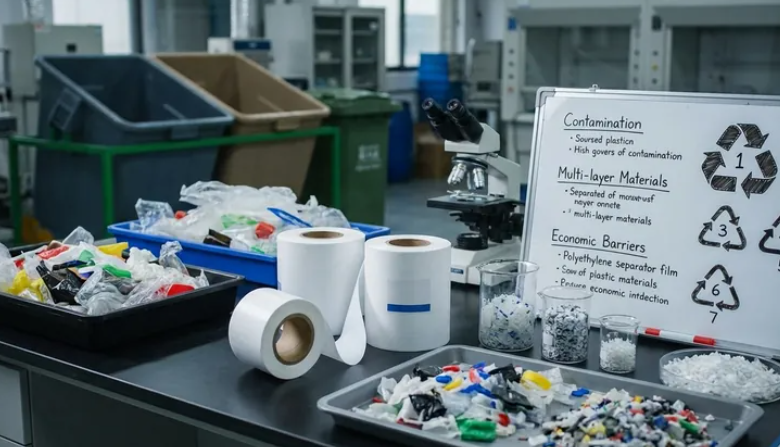
Plastic recycling is often described as a straightforward process: collect waste material, process it, and turn it into something that can be used again. In practice, however, producing usable recycled material involves much more than simply reducing plastic waste into smaller pieces.
The quality and consistency of incoming material can influence nearly every stage that follows. Differences in material type, contamination, moisture, and particle size can make recycling operations more difficult to control and can affect the characteristics of the final recycled product.
For manufacturers and recyclers working with post-industrial or post-consumer plastics, this makes material preparation an important part of the overall production process.




Recycling Starts With Understanding the Material
Not all plastic waste behaves in the same way. Even materials that appear similar can have different properties depending on their resin type, previous use, additives, or level of contamination.
Mixing incompatible materials can create challenges during processing and may limit the applications for the recycled output. For this reason, many recycling operations focus on sorting and preparing materials before they enter later stages of production.
Industrial recycling can offer an advantage when the source material is relatively consistent. Manufacturing scrap such as production trim, rejected parts, purgings, and off-spec material may be easier to identify and separate than mixed consumer waste. Keeping material streams organized from the beginning can simplify later processing and help recyclers maintain more predictable results.
Why Consistency Matters During Processing
A recycling line operates most effectively when the material entering the system is reasonably consistent.
Large variations in feedstock can require operators to make frequent adjustments and may create fluctuations throughout the production process. Material that contains excessive moisture or contamination can introduce additional challenges, while inconsistent particle size may affect how efficiently the material moves through subsequent equipment.
The goal is not necessarily to make every piece of incoming material identical. Instead, it is to create a processing flow that can handle the material reliably and produce a more consistent output.
This is where proper preparation and equipment selection become closely connected.
The Role of Size Reduction and Granulation
Size reduction is an essential step in many plastic recycling operations. Large pieces of plastic can be difficult to handle efficiently, while material prepared in a more manageable form can be easier to process, transport, and feed into downstream systems.
The exact requirements depend on the type of plastic and the overall recycling process. Some materials may require shredding before further processing, while others may move through grinding or granulation stages.
Modern plastic granulation equipment can play an important role in preparing material for the next stage of recycling. The objective is not simply to reduce size as quickly as possible, but to support a stable and manageable material flow that fits the requirements of the wider production process.
When this stage is properly integrated with upstream and downstream operations, it can help make the entire recycling line easier to manage.
Looking Beyond Individual Machines
One common mistake in industrial recycling is to evaluate each piece of equipment separately without considering how the entire process works together.
A recycling system is made up of connected stages. Changes in material preparation can influence feeding, processing, filtration, and the quality of the final output. A bottleneck in one area may reduce the efficiency of the entire operation.
This is why manufacturers increasingly look at recycling as a system rather than a collection of individual machines. The most appropriate equipment configuration depends on factors such as material type, contamination levels, production volume, and the intended use of the recycled material.
A solution that works well for clean production scrap may not be suitable for a mixed or heavily contaminated material stream.
Process Control Is Becoming More Important
As recycling operations become more sophisticated, manufacturers are placing greater emphasis on process control and repeatability.
Consistent feeding, stable operating conditions, and reliable monitoring can help operators identify changes before they develop into larger production problems. Automation can also reduce the need for repetitive manual adjustments and provide better visibility into how equipment is performing.
However, automation alone does not solve every problem. The condition of the incoming material remains one of the most important factors in any recycling process.
A well-designed system works best when equipment, operating procedures, and material preparation support each other.
Improving Efficiency Without Oversimplifying the Process
There is increasing pressure on recycling companies to improve productivity while controlling operating costs. This has encouraged greater interest in automation, energy efficiency, and equipment that can operate reliably over extended production periods.
But efficiency should not be measured only by throughput.
A system that produces a high volume of inconsistent material may create additional costs later through reprocessing, quality issues, or limited applications for the final product. In many cases, a stable process that produces a consistent output can provide greater long-term value.
This is particularly relevant as recycled materials are increasingly used in applications that require more predictable material properties.
Building a More Reliable Recycling Operation
Successful recycling operations are built around a clear understanding of the material being processed.
Before investing in equipment or expanding capacity, manufacturers should consider questions such as:
- What types of plastic will be processed?
- How consistent is the incoming material?
- What contaminants may be present?
- What level of preparation is required before further processing?
- How will the recycled material be used after production?
Answering these questions can help companies select equipment and design processes that match their actual requirements rather than relying on a one-size-fits-all approach.
The Bigger Picture
Plastic recycling is becoming a more important part of modern manufacturing, but the industry continues to face practical challenges related to material quality, processing efficiency, and consistency.
Improving recycling outcomes does not always require a single breakthrough technology. Often, meaningful improvements come from managing the details of the process more effectively—from separating materials at the source to preparing them properly before they move through the production line.
As demand for reliable recycled materials continues to grow, manufacturers that focus on process stability and material consistency will be better positioned to make the most of available resources.
Conclusion
The success of a plastic recycling operation depends on more than what happens at the final stage of production. The way materials are identified, prepared, and processed can influence the efficiency and reliability of the entire system.
By focusing on consistent material preparation and selecting equipment that supports the needs of the overall process, recyclers can build operations that are easier to manage and better suited to producing usable recycled materials.
In the long run, effective recycling is not simply about processing more plastic. It is about creating a controlled process that makes better use of the material already available.