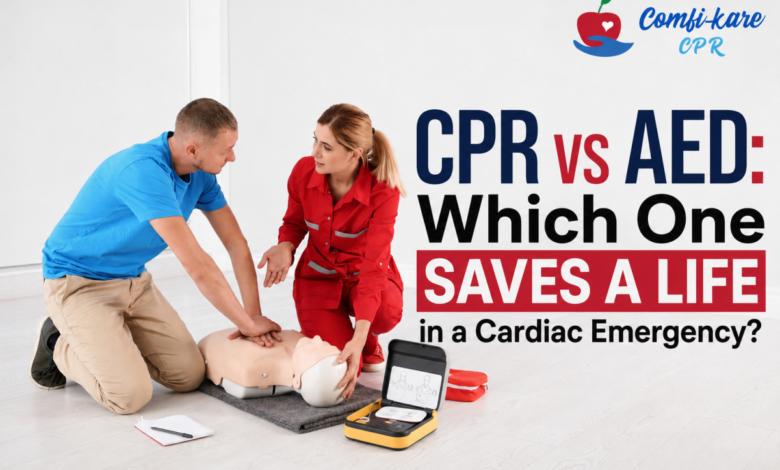
Ask a room of people what they’d do if someone collapsed in front of them, and you’ll hear the same hesitation surface almost every time: start compressions, or go find the defibrillator? The CPR vs AED question feels like a fork in the road. It isn’t. It’s the single most common misunderstanding in bystander response, and the seconds burned deciding are seconds nobody gets back.
Here’s the short version: you do both. CPR starts now, the AED gets used the moment it’s in your hands. Neither one replaces the other, and treating them as alternatives is how people lose the first three minutes of an emergency.
They solve two completely different problems
CPR is a circulation problem solver. Chest compressions manually push blood — and the oxygen in it — toward the brain and organs when the heart has stopped moving it. That’s the entire job. CPR does not restart a stopped heart. It buys time, and time is the only currency that matters in cardiac arrest.




An AED solves an electrical problem. In many sudden arrests, the heart hasn’t stopped so much as descended into chaos — ventricular fibrillation, where the muscle quivers uselessly instead of pumping. A defibrillator momentarily flatlines all that electrical noise so the heart’s natural pacemaker gets a clean shot at resuming a normal rhythm. Compressions cannot do this. No amount of pushing on someone’s chest will correct a lethal arrhythmia.
So the question was never which one works. It’s that they work on different failures, at the same time.
See also: How Choosing Professional Water Damage Restoration Transforms Your Home
Why the shock only works if compressions came first
This part gets skipped a lot. Defibrillation is only effective if the heart tissue is still viable enough to respond to it. Viability depends on perfusion. Perfusion, in a person whose heart isn’t pumping, depends entirely on someone’s hands on their chest.
Which means CPR isn’t a placeholder you do while waiting for the real intervention. It’s what makes the real intervention capable of working. A shock delivered to a heart that’s gone four minutes without any blood flow is a much worse bet than the same shock delivered after four minutes of solid compressions. If you want the real difference between CPR and an AED broken down further, the physiology is worth reading in full.
What this looks like in practice
Unresponsive, not breathing normally? Treat it as cardiac arrest. Don’t spend time confirming.
Call for help, and name a person. “You in the blue jacket — call 911. You — get the AED from the front desk.” Vague requests to a crowd get ignored. Direct ones don’t.
Start compressions immediately. Center of the chest, 100 to 120 per minute, at least two inches deep, full recoil between each one. Push harder than feels polite.
Don’t leave to hunt for an AED if you’re alone and one isn’t close. Compressions beat a five-minute search.
When the AED arrives, keep compressing while someone powers it on and applies pads to bare skin. The device will tell you when to pause.
After a shock — or after “no shock advised” — resume compressions instantly. Don’t check for a pulse. Don’t wait.
“No shock advised” is not a dismissal, by the way. It means the rhythm isn’t one defibrillation can fix, which makes continued CPR more important, not less.
The fears that stop people are mostly unfounded
Two hesitations do most of the damage. The first is worry about using an AED wrong — but the device analyzes the rhythm itself and will not deliver a shock unless it detects one that needs it. It talks you through every step. You cannot accidentally shock a healthy person with it.
The second is legal. Good Samaritan laws in most states protect people who help in good faith during an emergency, including with CPR and AED use. The details vary by state, but the intent behind them doesn’t: the law was written to get bystanders moving, not to punish them for trying.
Confidence comes from reps, not reading
Knowing the sequence and executing it while someone’s family is screaming next to you are different skills. Hands-on practice is what closes that gap — feeling how hard two inches actually is, running the pads onto a manikin, working through a shock with someone counting on you. Comfi-Kare CPR runs certification courses that cover both, and certification generally runs two years before a refresher is due.
The people who act fastest in a real emergency aren’t braver than everyone else. They’ve just done it before.