How Does 5 Axis Machining Achieve ±0.005mm Accuracy for Aerospace Parts While Saving 40% on Costs

Introduction
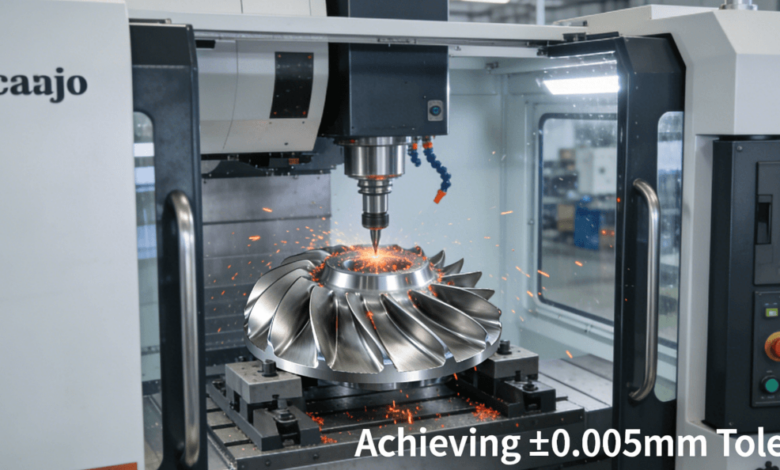
However, the aerospace manufacturing sector is currently in a state of increased difficulty, as the geometry of the components is becoming increasingly complex, difficult-to-cut materials are widely used, and the tolerance for the features must be maintained within ±0.005mm.Besides, the usual 3-axis machining method also finds it difficult to handle the complex shapes and deep cavities, and changing the setups multiple times will cause the cumulative positioning errors, thus increasing the time and production costs.
This article is mainly about how 5-axis CNC machining technology by itself can solve these problems completing a complex form single setup only, thereby accuracy and productivity are going to be improved significantly. Other aspects such as materials, compliance, and cost optimization will also be covered in detail. The five essential questions below will clarify the significance of 5-axis machining in the aerospace industry.
Why is 5-axis CNC Machining Technology Imperative for Aerospace Manufacturing?
More and more, aerospace development is demanding components having complicated, natural shapes for instance, turbine blades exhibiting aerodynamic airfoils or structural brackets with deep pockets and compound angles. Standard 3-axis machines are only able to move in straight lines in three directions (X Y Z) and therefore, in order to work on all the features of the part, the machine will most likely require several re-fixturings which needless to say, are very time-consuming, operations.Moreover, each new setup presents the possibility of misalignment which can cause the accumulation of errors and that ultimately the very stringent aerospace precision machining standards might be compromised.

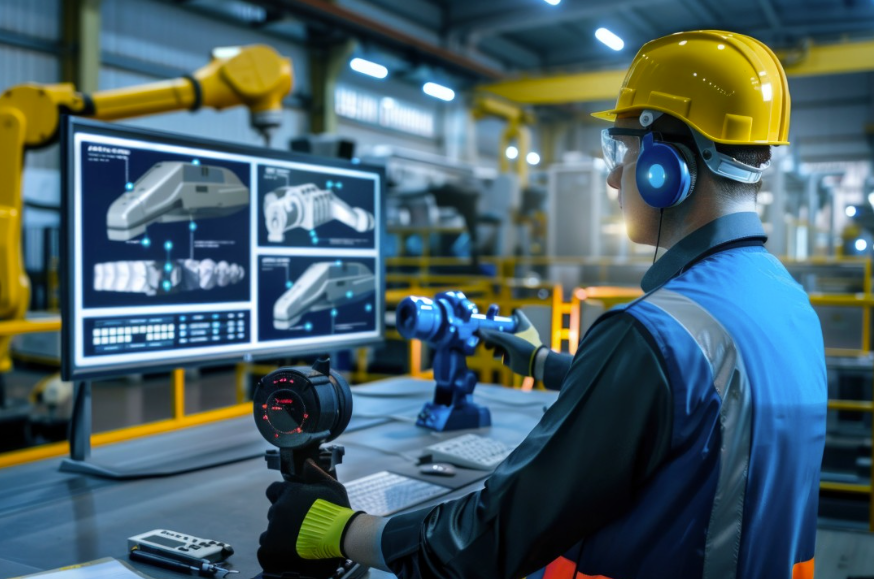


Aerospace 5-axis Machining dramatically changes this paradigm. With the addition of two rotational axes (usually A and B or C), the tool or workpiece can be positioned at almost any angle. Complex parts like integrally bladed rotors (blisks), engine casings, and wing spars can be machined in a single setup. Among the principal benefits, probably the most significant is the lowering of the overall tolerance error by a very large margin, which ensures that features such as the fit of two parts and the holes for the location retain their correct positional relation. Moreover, 5-axis technology allows shorter,and therefore more rigid, cutting tools to be used. These tools can then be run at the best speeds and feeds, resulting in better surface finish, longer tool life, especially when machining very hard materials so characteristic of aerospace. This capability to perform accurately is one of the main reasons why there is innovation; it goes hand-in-hand with, for instance,National Aeronautics and Space Administration advanced manufacturing research which concentrates on developing technologies for lighter, stronger and more efficient aerospace structures. For the manufacturers it implies the production of top-notch aerospace parts manufacturing reliably from a single piece of material.
How to Select Suitable Materials for Aerospace 5-Axis Applications?
Choosing materials is an important part of aerospace design because it involves considering factors such as weight, strength, and thermal properties.Material selection can be a make or break factor in terms of manufacturability, cost, and overall performance.5 axis CNC machining center capabilities are essential for the efficient machining of aerospace materials.
Machining Demanding Aerospace Alloys
Machining high-performance aerospace alloys like titanium and stainless steel 5-axis machining is a serious job and the use of precise techniques method to deal with the challenges that arise while machining the properties of these materials technically reinforce the importance of Professional Expertise.
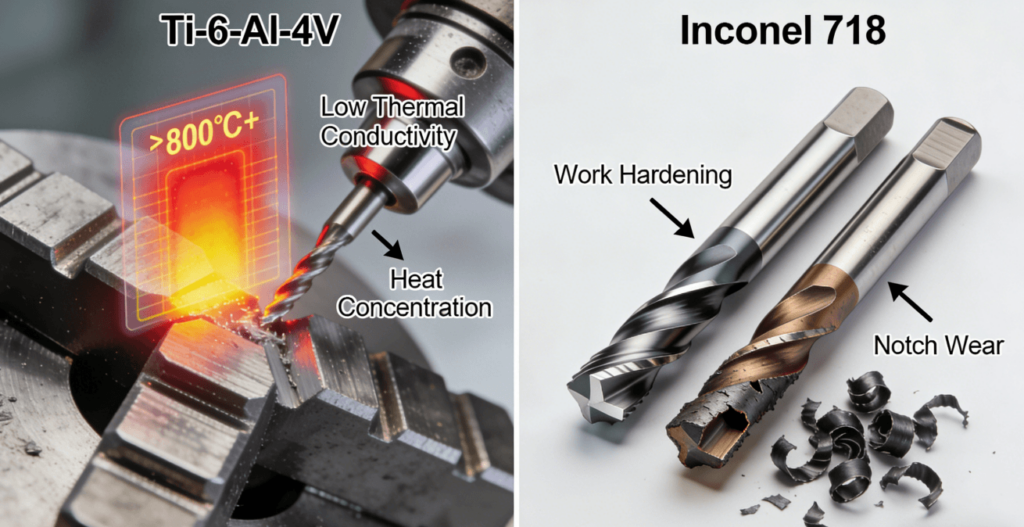
- Titanium’s Thermal Challenge:
The main challenge that arises when machining titanium aerospace parts 5-axis machining is heat dissipation, which hastens tool degradation and warpage of the parts. - Inconel 718’s Hardness:
The problem for Inconel 718 aerospace machining 5-axis is the work-hardening, abrasive nature of Inconel, which can lead to rapid tool notch wear.
Aluminum and Other Common Alloys
High-strength aluminum alloys are chosen for their favorable machinability and strength-to-weight ratios. They are often used for brackets, housings, and other structural parts. Stainless steel and composite alloys are chosen for parts requiring specific properties.
How Does 5-Axis Machining Ensure ±0.005mm Precision for Aerospace Parts?
However, the achievement and maintenance of tolerances within a deviation limit of ±0.005mm is a non-negotiable condition for aerospace applications. A 5 axis CNC mill achieves this through a number of technological and methodological advantages.
The basic philosophy is the minimization of errors through single-setup machining. In this approach, the vast majority, if not all, of the machining tasks are accomplished within a single fixture. This is the basic philosophy for aerospace precision machining. Modern 5-axis machines incorporate a number of technological advances to further improve precision. Real-time dynamic precision compensation accounts for the deflection of the machine under load; thermal error control systems compensate for spindle and frame expansion; and on-machine probing allows for verification and updating the tool offset.
Similarly, process planning is also of critical importance. This is because advanced CAM systems are now available that produce optimized CNC 5 axis milling toolpaths that keep the tool engagement angle constant, thus maintaining uniform cutting forces and preventing any vibrations that could cause chatter, thereby compromising accuracy. Additionally, fixture design that is strategically developed for maximum stiffness and minimal deflection of the workpiece due to clamping is also critical. This is a complete solution that not only provides advanced capabilities of machine tools but also utilizes software and process engineering to ensure that the standards set by organizations such as SAE International for flight components are met.
What International Certifications and Compliance Requirements are Needed for Aerospace 5-Axis Machining?
Aerospace manufacturing takes place in one of the world’s most heavily regulated environments, and compliance is not optional; it’s a requirement, a foundation for safety and airworthiness. Being a qualified supplier starts with having the appropriate certifications in hand.
The core of aerospace quality management systems is defined in the AS9100D standard, which includes a set of best practices based on the widely adopted ISO 9001 standard, as well as additional best practices specifically for the aerospace industry, which include risk management, configuration management, and counterfeit part prevention. This standard calls for Commercial Applications of quality best practices, ensuring that every part is traceable, conforming, and reliable, which in turn shows a manufacturer’s dedication to a culture of continuous improvement and defect prevention.
Apart from AS9100D, other standards have important roles to play. ISO 9001 sets the standard for the quality management system. IATF 16949, while being a standard for the automotive industry, has APQP and PPAP concepts that are beneficial to the aerospace industry. ISO 14001 deals with environmental aspects, which are becoming increasingly important. The entire supply chain requires Professional Expertise to ensure full traceability of the entire process from the mill certificates of the raw material to the inspection reports. A robust compliance structure not only ensures compliance but also speeds up the airworthiness certification process, which is a time-consuming and complex procedure for the end customer.
See also: The Zombie Subscription: Firms Waste Millions on Unused Tech Tools
How to Optimize Production Cost and Lead Time for Aerospace Parts via 5-Axis Machining?
Although the initial investment in 5-axis equipment is substantial, the use of this equipment provides substantial savings in total cost of ownership (TCO) and reduces cycle times, which is a strategic advantage for aerospace parts manufacturing that is sensitive to costs.
Direct Cost Savings through Process Consolidation
The most direct cost savings is the reduction in setups, which is substantial. A complex part that might entail 4 or 5 different processes on a 3-axis machine might only need 1 or 2 setups on a 5-axis machine. This cuts the non-value-added time that is usually involved in handling, fixturing, and inspecting a part between processes. It also reduces the cost of fixtures, space, and, most importantly, scrap rate that is caused by the cumulative effect of errors. Quantifiable savings of 20-40% of total part costs are achievable.
Accelerating Time-to-Market
Manufacturing Services that incorporate the use of 5-axis machining are naturally compressed in terms of production schedules. The single-setup production means that the part goes directly from the raw material to the finished part in one single process flow. The integration of digital thread technologies, where 3D models are utilized to simulate, generate tool paths, and inspect the parts, greatly compresses the “design-to-part” timeframe.
Design for Manufacture (DFM):
The utilization of the 5-axis machining center allows the engineer to produce integrated, lightweight monolithic parts, eliminating the need for parts that are assembled together with fasteners.
Supply Chain Simplification:
Making the full, finished part ready for installation internally drastically streamlines the supply chain, getting rid of the problems of logistics, quality control at several vendors, and the total administrative expenses. To reap the rewards of these efficiencies. it is essential to collaborate with a company that provides complete 5 axis CNC machining services so that the right engineering support can be provided to optimize the process from the beginning.
Conclusion
Currently, 5-axis CNC machining is a must-have in aerospace fields because it helps to solve the main issues: how to make complex parts with just one setup, how to keep 0.005 mm tolerances, how to machine hard material like titanium, and how to comply with the strict AS9100D standards etc.When done effectively, it can increase efficiency and save a lot of money, so talking to a trusted vendor beforehand becomes the most important step for your upcoming project.
Author Bio
This article has been written by a precision manufacturing expert with over 15 years of technical experience in the aerospace sector. The author is a known contributor to international aerospace projects especially in the areas of 5-axis machining process optimization and solutions for difficult-to-machine materials. Besides this, the article also reflects the best practices and on-field experience of top manufacturing service providers like CNC Protolabs.
FAQs
Q1: What are the major benefits of 5-axis machining compared to 3-axis?
A: With 5-axis machining, it is possible to create complex shapes and deep cavities in a single set-up, which not only eliminates the errors coming from multiple fixtures but also enhances the accuracy to 0.005mm and reduces the machining time to 30-50%, making it the perfect choice for manufacturing complex aerospace parts.
Q2: What are the special challenges in 5-axis machining titanium alloys?
A: Titanium has a very low thermal conductivity which means that the heat generated at the cutting edge cannot be dissipated quickly and the temperature rises rapidly, this leads to blade wear and can cause deformation of the workpiece. Specialized tools, proper selection of cutting parameters and top-notch cooling techniques are crucial to effectively control the “heat affected zone” (HAZ).
Q3: Why is the AS9100D certification a must for an aerospace manufacturer?
A: AS9100D specifies the requirements for a quality management system and is the most widely accepted international standard for the aerospace industry. Besides a thorough control of processes, traceability, and reliability leading to a very high level of quality in this field, the certification also helps aerospace manufacturers to demonstrate their compliance with the highest quality standards of the entire supply chain.
Q4: How can you vet the technical skills of a 5-axis machining supplier?
A: One should review the make, year and accuracy parameters of their 5-axis machines; the supplier’s track record of working with tough aerospace materials such as titanium and Inconel; a quality control system certified by recognized authorities (e.g. AS9100D); the level of skills held by their engineering support team; and recent cases of significant projects.
Q5: How can 5-axis machining help reduce the overall cost of an aerospace component?
A: 5-axis machining may significantly lower the total parts cost by 20-40% due to minimum fixturing requirements, shorter cycle time, less scrap rate, and better material usage through efficient nesting, whereas simultaneously producing parts with a superior quality level and higher reliability.