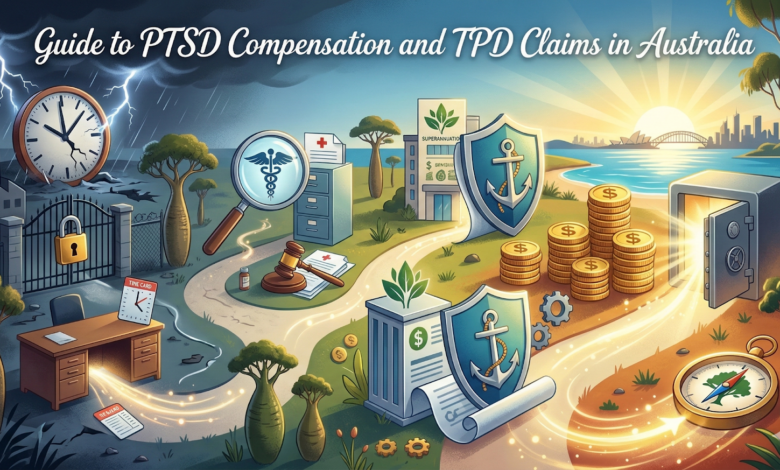
Post-Traumatic Stress Disorder (PTSD) has a profound impact on an individual’s life. It can change how you interact with loved ones, disrupt your daily routines, and severely limit your ability to work. Fortunately, Australian legal and medical systems increasingly recognize the severity of mental health injuries. This growing awareness means that individuals suffering from psychological trauma have valid paths to seek financial support.
The purpose of this article is to demystify the legal and financial avenues available for people living with PTSD. Navigating the complex world of insurance can feel overwhelming when you are trying to manage your health. We will specifically focus on two main sources of financial relief: workers’ compensation payouts and superannuation insurance claims.
Many Australians hold Total and Permanent Disability (TPD) insurance through their superannuation fund without even realizing it. This hidden coverage can provide a vital financial safety net if a severe psychological condition prevents you from maintaining employment. Checking your super fund details is often the first step toward securing your future.




Throughout this guide, you will learn the fundamental differences between workers’ compensation and TPD. We will explain the specific eligibility criteria for mental health claims and provide a clear, step-by-step breakdown of the claims process. Finally, we will share practical advice on how to maximize your chances of a successful outcome.
Understanding PTSD in a Legal Context
In Australia, the legal assessment of PTSD requires strict medical documentation. You cannot simply claim to feel stressed or anxious after a bad experience. To pursue any form of compensation, you must receive a formal diagnosis from a qualified psychiatrist. This medical professional will use established diagnostic criteria, such as the DSM-5, to confirm that you exhibit symptoms like re-experiencing the trauma, avoidance behaviors, and severe hyperarousal over an extended period.
Common scenarios that lead to PTSD claims frequently involve highly stressful or dangerous environments. For example, first responders like police officers and paramedics are at a high risk of developing psychological trauma due to their routine exposure to distressing events. Similarly, severe motor vehicle collisions can leave survivors with debilitating fear and anxiety that prevent them from driving or functioning normally. Workplace accidents, physical assaults, or witnessing a tragic event on the job are also frequent triggers for successful mental health claims.
[Graphic placeholder: An illustration detailing the common symptoms of PTSD, such as panic attacks, severe sleep disruption, flashbacks, and emotional numbness, which prevent individuals from returning to their normal employment.]
What is a TPD Insurance Claim?
Total and Permanent Disability (TPD) insurance is a specific type of cover designed to financially protect you if you suffer an injury or illness that stops you from working. Most employed Australians have this insurance automatically bundled within their default superannuation account. It pays out a substantial one-time sum that you can use to clear debts, pay for ongoing medical treatments, or simply support your family.
A TPD claim contrasts significantly with standard workers’ compensation. Workers’ compensation generally provides ongoing weekly payments for lost wages and covers your medical bills. TPD, on the other hand, is a single lump-sum payout. Furthermore, Total and permanent disability insurance claims do not require you to prove that someone else was at fault for your condition. You can claim TPD regardless of how or where you acquired PTSD, as long as the condition permanently prevents you from working.
When reviewing your TPD policy, you must pay close attention to the specific definitions of disability. Policies generally fall into two categories: “Any Occupation” and “Own Occupation.” An “Own Occupation” policy covers you if you can no longer work in the specific job you held before your diagnosis. An “Any Occupation” policy is stricter. It requires you to prove that your PTSD prevents you from working in any role suited to your education, training, and experience. These specific policy terms drastically impact your eligibility and the type of medical evidence you need to provide.
Eligibility for PTSD Compensation in Australia
Filing a successful workers’ compensation claim for a psychological injury requires you to meet specific legislative criteria. The requirements for mental health conditions are often more heavily scrutinized than physical injuries. To qualify, you must show that you suffer from a diagnosed psychiatric ailment that severely impairs your ability to function in the workplace.
The burden of proof rests heavily on the claimant. You must show that your employment was a significant contributing factor to your PTSD diagnosis. If your condition resulted from a single traumatic event at work, the connection is usually straightforward. However, if your PTSD developed over time due to chronic workplace stress or bullying, you will need comprehensive documentation to prove the link between your job environment and your declining mental health.
When seeking lump-sum Compensation payouts for PTSD Australia under a workers’ compensation scheme, you will undergo a psychiatric assessment to determine your Whole Person Impairment (WPI). The assessing doctor assigns a percentage score based on how severely your condition restricts your daily activities. You must reach a specific statutory threshold, which varies by state, to qualify for a permanent impairment lump-sum payout.
How TPD Claims Work for Mental Health Conditions
Filing a TPD claim for a mental health condition like PTSD presents unique challenges compared to claiming for a physical injury. An amputated limb or a severed spinal cord provides immediate, visible proof of permanent disability. Psychiatric injuries are invisible, making them harder to quantify and easier for insurers to question.
A major hurdle is the requirement to prove that your PTSD is “permanent.” Psychological conditions can fluctuate, with periods of remission followed by severe relapse. Insurers will look closely at your treatment history. You must demonstrate that you have exhausted all reasonable treatment options. This means showing that you have consistently attended therapy, tried prescribed medications, and followed your psychiatrist’s recommendations, yet your condition has not improved enough to allow a return to work.
Consider the case of a school teacher who witnessed a tragic accident involving students on the school grounds. The teacher developed severe PTSD, suffering from daily flashbacks, panic attacks, and an inability to be around large groups of children. Despite attending weekly cognitive behavioral therapy and trying multiple anxiety medications over two years, the teacher’s condition remained stagnant. Because medical experts confirmed that all reasonable treatments had failed and the teacher could never return to a classroom environment, the superannuation fund eventually approved a successful TPD payout.
The Claims Process Step-by-Step
Gathering Medical Evidence
The foundation of any successful insurance claim is comprehensive medical evidence. You must collect all records relating to your condition from the date of the incident or the onset of your symptoms. This includes treatment notes from your general practitioner, ongoing reports from your psychologist, and the formal diagnosis and prognosis from your treating psychiatrist.
During the claims process, the insurer will likely require you to attend an Independent Medical Examination (IME). An IME is an assessment conducted by a doctor chosen and paid for by the insurance company. This doctor will evaluate the severity of your PTSD and provide an opinion on your capacity to work. It is highly recommended to seek legal guidance before attending an IME to ensure you understand your rights and the purpose of the examination.
Lodging the Claim
To initiate the process, you must notify your superannuation fund or the relevant workers’ compensation insurer of your intent to claim. The insurer will send you a claim pack containing multiple forms. You should request these forms as soon as you realize your condition is permanent, as strict time limits can sometimes apply.
Accurately completing the claimant statement is crucial. You must provide a thorough and honest account of your work history, your daily symptoms, and how your PTSD impacts your life. The insurer will also require an employer statement detailing your job duties and the date you ceased working. Any inconsistencies between your statement, your medical records, and your employer’s statement can lead to significant delays.
Waiting Periods and Assessments
The assessment phase requires a great deal of patience. The typical waiting period for a decision on a TPD claim ranges from 6 to 12 months. Mental health claims often take longer due to the complex nature of psychiatric assessments and the need to verify that the condition has stabilized.
Insurers frequently request additional information during this period. They may ask for updated medical reports or clarification on your employment history. Respond to these requests promptly to keep the process moving. Be aware that insurers sometimes use surveillance practices to monitor claimants. They do this to ensure your daily activities align with your reported symptoms. Always be truthful about your limitations, as misleading the insurer can ruin your claim.
Average Payouts and Financial Support
TPD lump-sum payouts are calculated based on the specific terms of your superannuation policy and your account balance at the time you stopped working. Because everyone’s superannuation setup is different, payout amounts vary widely. Most successful claims fall between $50,000 and $500,000. Some individuals with multiple superannuation accounts may be eligible to claim on several policies, significantly increasing their total financial support.
Workers’ compensation provides a different structure of financial aid. If your claim is approved, you will receive regular weekly payments designed to replace a portion of your lost wages. The insurer will also cover the cost of reasonable and necessary medical expenses, including trauma therapy, psychiatric consultations, and prescription medications.
Withdrawing a TPD payout from your superannuation fund before reaching retirement age can trigger potential tax implications. While the payout itself might be classified in a specific way, taking the cash out of the super environment often incurs a tax penalty. Consulting with a financial advisor or accountant can help you understand these deductions and plan your finances accordingly.
Common Roadblocks and How to Overcome Them
Insurance companies are businesses, and they thoroughly investigate claims to minimize their financial risk. It is very common for insurers to initially reject mental health claims. They often dispute the severity of the condition, arguing that the claimant retains some capacity to perform alternative work. They may also point to pre-existing mental health issues, suggesting that the current disability is not entirely due to the claimed trauma.
If your claim is denied, you have options. The first step is usually an internal dispute resolution process. You can submit a formal complaint to the insurer, providing additional medical evidence to challenge their decision. If the insurer upholds the denial, you can escalate the matter to external bodies, such as the Australian Financial Complaints Authority (AFCA), which provides an independent review of superannuation disputes.
Retaining a lawyer who specializes in TPD and PTSD compensation can significantly improve your chances of a favorable outcome. Specialist lawyers understand the specific tactics insurers use to deny claims. They know how to brief medical experts properly, ensuring that the resulting reports directly address the complex legal definitions in your policy. Having professional representation removes the burden of communicating with the insurer, allowing you to focus entirely on your mental health recovery.
Summary
Understanding the legal landscape is the first step toward regaining control over your life. Workers’ compensation requires proof that your employment caused your condition, offering ongoing wage replacement and medical coverage. TPD insurance, often hidden within your superannuation, provides a lump-sum payment if your condition permanently prevents you from working, regardless of fault. Financial support is available for those suffering from severe psychological injuries.
Navigating complex insurance policies while dealing with the daily realities of trauma can be incredibly overwhelming. You do not have to handle the paperwork, the medical assessments, and the insurer negotiations on your own. Expert advice is crucial to ensure you meet all necessary criteria and receive your full entitlements.
If you or a loved one are struggling with PTSD and cannot work, please reach out to our specialized mental health compensation legal team. We offer a free, confidential case assessment to determine your eligibility and guide you toward a more secure financial future.